Samurai Strategies |
|
23 February 2026 - Adetswil
Boyé Lafayette de Menthe has written many books on Japan. This particular one, Samurai Strategies, is a dual commentary on a 17th century samurai text, Musashi Miyamoto's The Book of Five Rings (五輪書). And I say dual commentary because although he is not on the cover, Michihiro Matsumoto contributes a commentary on every chapter of the book. As fitting with de Menthe's typical style though, the chapters are short essays around a particular principal ("martial secret") from Musashi's book.
The introduction starts off with explications of the seven virtues (七徳) of the samurai way, although Musashi apparently never explicitly listed them in his book. And, as with many books expounding "secret" eastern wisdom, there is a bunch of foreign vocabulary to learn right away. By de Menthe the virtues are
- kennin (堅忍) - perseverance, fortitude
- shinnen (信念) - belief, faith, conviction
- shinchō (慎重) - prudent, careful, cautious
- seigi (正義) - justice, righteousness
- sessei (節制) - moderation, self-restraint, temperance
- jizen (慈善) - charity, philanthropy
- kibō (希望) - hope, wish, aspiration
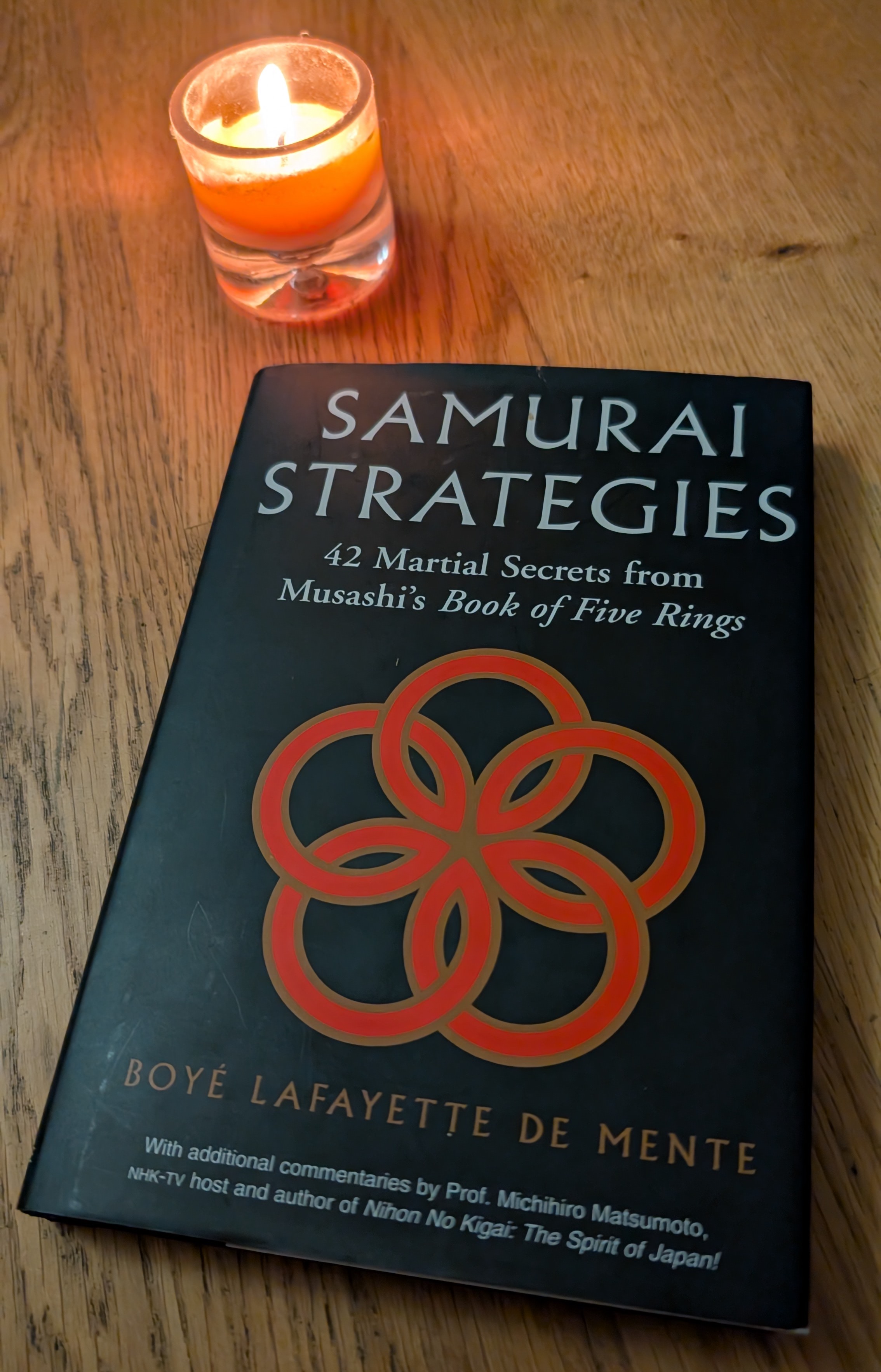
The 42 "secrets" de Menthe outlines in this relatively short book are fairly timeless and cross-cultural:
- Set goals
- Have life-or-death discipline
- Train to win
- Be prepared
- Dismiss the illusion of form
- Have absolute integrity
- Train the mind
- Clear the mind
- Know the power of emptiness
- Learn from your opponents
- Pay attention to details
- Use the power of silence
- Change the rules of engagement
- Use the power of fear
- Confuse your opponent
- The mind is a weapon
- See what cannot be seen
- Don't get stuck in one style
- Know the importance of flexibility
- Make sure you see the big picture
- Use time as a weapon
- Never stop learning
- Hit first; hit hard!
- Use all your weapons
- The samurai should think like a carpenter
- Take the initiative
- Know your environment
- Watch for a collapse
- Become your opponent
- Draw your opponent in
- Never use the same tactic more than twice
- Make your opponent change his style of fighting
- Behave as if you were already dead
- Avoid stalemates
- Never give your opponent a second chance
- Pierce the bottom
- Art is important in life
- A strong spirit is like a sword
- Focus on winning
- Have the head of a rat and the neck of a bull
- Surpass today what you were yesterday
- Have perseverance and diligence
It is also significant that most of this advice only applies to competitive finite games where there is a winner and a loser. In cooperative games (where you must work together to achieve a common goal) and infinite games (where the goal is to just keep playing the game) a lot of the above advice is just downright self-defeating. Matsumoto, however, seems to think that all Japanese would benefit from going back to training children the samurai way, while de Menthe is more circumspect in his conclusion. Definitely a more polemic book than I was expecting!