Eight BearsPrevious | Books | Films | Garden | Index | 日本語 | Training | Next |

|
11 March 2026 - Erlenbach
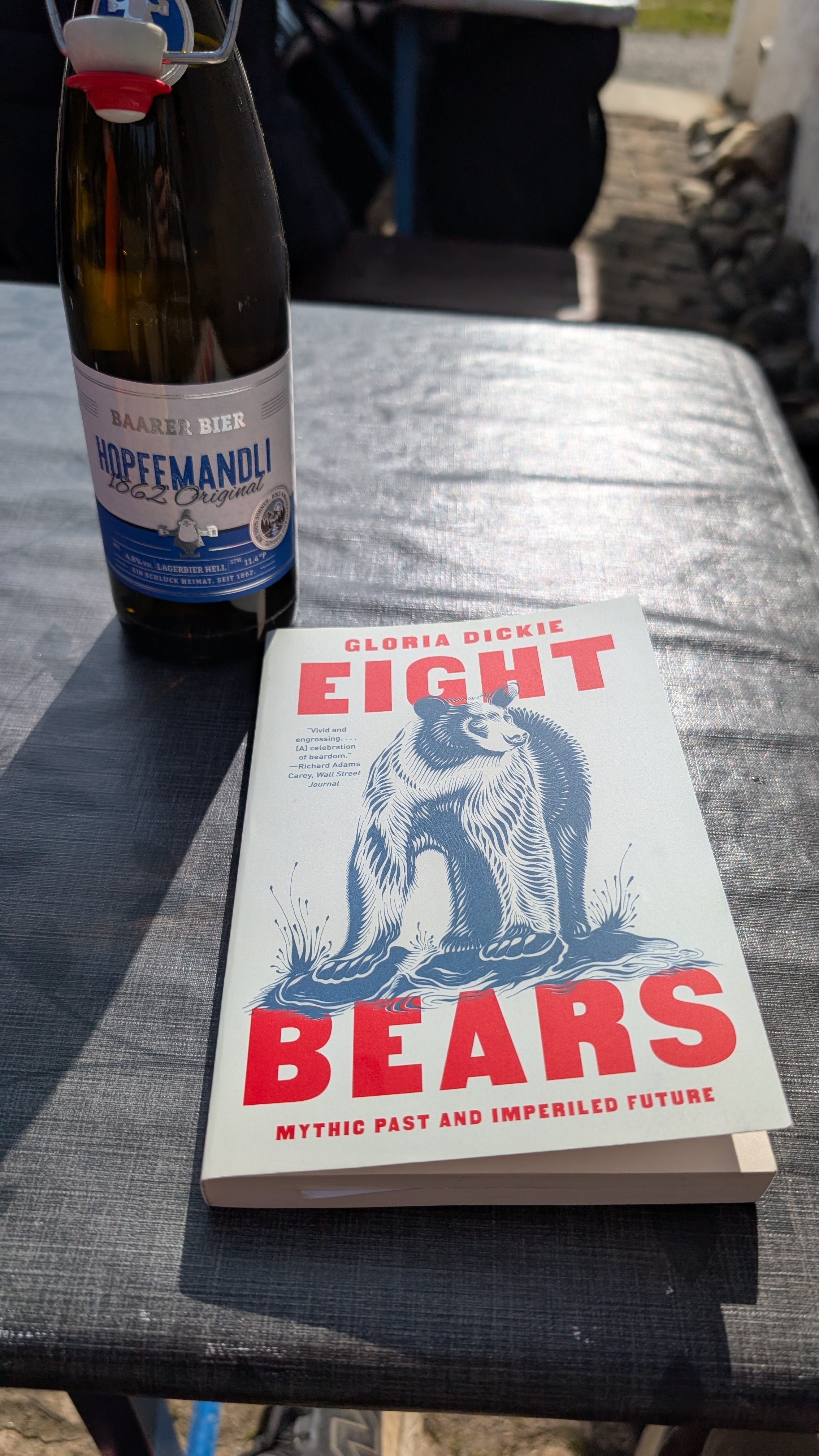
I've been wanting to read Gloria Dickie's Eight Bears for several years now. My attempts to order it from Amazon have led to delays and eventual cancellation, but Ex Libris was able to finally get it to me. Amazingly, she starts in Boulder, Colorado, where I first encountered a bear, a black bear, in an urban environment back in 2017 while attending a conference. The police were protecting it and people like me by keeping the road our AirBnB was on blocked off, so we had to go back to the bar for a few more hours. I'd seen bears in the wild before, but never in a neighborhood. This was also after hitting a deer on the drive to Colorado, so it was a week filled with wildlife!
The reflection from the black bear's eyes is visible in the tree
A decade earlier on the other side of the continent in the Smokies I had my closest encounter with a black bear. In the fading light hiking back from Abrams falls with Zara on my front, Maxwell on my back, and Molly on a leash, a black bear heading down to the creek passed 30 feet in front of us. Fortunately Molly was fairly blind by this point and didn't bark. I backtracked to the twins and my wife to warn them and wait for the bear to get down to the creek. A family was mauled near this area a few weeks later, so we were lucky.
My Auntie Dell, who lives on Lake Tahoe, has to deal with brown bears which are not actually brown bears, but brown colored black bears. Confusing? Not at all. She has to keep her trash locked up and be careful with her dogs. Still they come. And we probably saw a grizzly bear (one of the brown bear subspecies) across a field in Yellowstone back in 2015, but it was quite far away so the pictures are too grainy to tell.
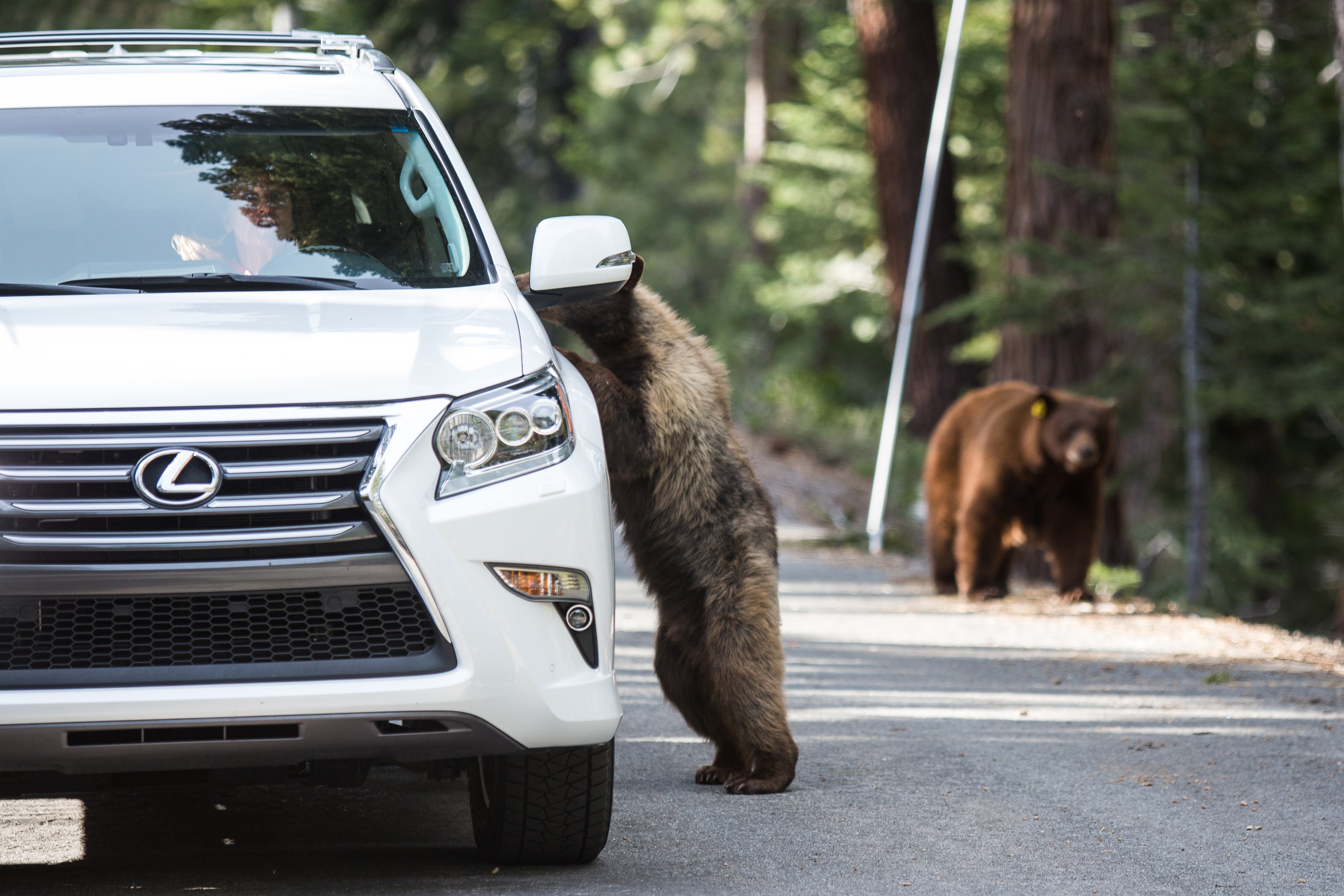
Curious cub investigates Dell in her car while mama watches (also 2017)
And then in 2018 I went to Svalbard. In Longyearbyen, the main city built by a Michigan coal miner, there are guns everywhere. This is because sometimes polar bear come into town and eat people. If you leave town, it must be armed or with an armed escort. The race I ran there had armed guards, but an unfortunate lack of water stations. On a boattrip afterward to Pyramiden, the Russian city in Norway, we passed a polar bear in the ice flow from the Nordenskjöld glacier enjoying a seal meal. I'd seen them in zoos before, but never in Nature. Later in Longyearbyen I also confirmed that seals are, in fact, quite tasty.
Distant polar bear snacking on a seal
Dickie, however, begins her book in South America with the spectacled bear. It's the ONLY species of bear in South America and it lives only in the Andes. Eight Bears is the name of the book because there are only eight species of bears left in the world. And polar bears can produce offspring with brown bears, so the divide there is more about fur color and eating habits. Dickie is a journalist by trade rather than a biologist, so the chapter on the spectacled bear is more about her traveling around Peru and not seeing them than the bears themselves.
Next on Dickie's itinerary is Asia, where she introduces what surprised me to be the world's deadliest bear, India's sloth bear. Here the narrative focuses on conversations with victims, from those with horribly disfiguring facial wounds to those who only received a bite in the leg. The strange part is that the sloth bear is so named because it's an insectivore with long claws for feeding on ants.
The panda bear. is probably the best known of Asian bears. China has control over the bear and an extensive breeding program to loan bears out to zoos in other countries as a form of soft power. Displease China and they will take their bears back.
Moving further east to Vietnam, Dickie plays sleuth trying to ferret a location where moon bears are kept to extract bile from. Used in traditional local medicine, it contains ursodeoxycholic acid which helps the bears survive hibernation, but also has a number of medical uses from lowering inflammation to liver disease. Sadly here Dickie succeeds in finding captive bears farmed for bile and describes their pitiful living conditions in excruciating detail.
The final bear unique to Asia is the sun bear. This is the smallest of bears and its range overlaps with the moon bear in southeast Asia. As does Dickie's chapter about the sun bear, because there is just a little bit of information about the sun bear inside the moon bear chapter.
The last three chapters are on the bears of North America, which I've mentioned above. Hilariously the black bear chapter focuses on stories from Incline Village, Nevada where my aunt lives. The bears there are a nuisance, but doing just fine. The brown bear chapter focuses on grizzlies and their expanding range in the lower 48 US states after their listing on America's endangered species list. Yellowstone here too is mentioned. Dickie ends with the polar bear in Churchill, Manitoba, Canada on the western coast of Hudson Bay. There the narrative returns to the theme of bear attacks and those happening in Svalbard also get mentioned.
Gloria Dickie is a journalist and not a scientist. This shows through in her writing style that attempts to connect the reader with the bears through personal stories rather than a lot of details about the bears biology, ecology, paleontology, range, etc. The book's subtitle is "Mythic Past and Imperiled Future", and, while we get a smattering of entho-cultural information about bears' place in humans' worldview, the focus is clearly on the imperilment of most bear species. In this vein Dickie makes her case well.